
How to Properly Measure an S-Camshaft
Measuring an S-camshaft is critical to maintaining the braking system on heavy-duty trucks and trailers. The S-camshaft is responsible for transferring the rotational force from the brake chamber into a linear force that engages the brake shoes, which in turn apply pressure to the brake drum, stopping the vehicle. Ensuring the S-camshaft is in good condition and properly sized for your vehicle can prevent brake failure and extend the life of your braking system.

Tools You Will Need:
- Vernier caliper or a micrometer
- Tape measure
- A flat surface or workbench
- Safety gloves and eye protection
- Replacement part number or reference manual
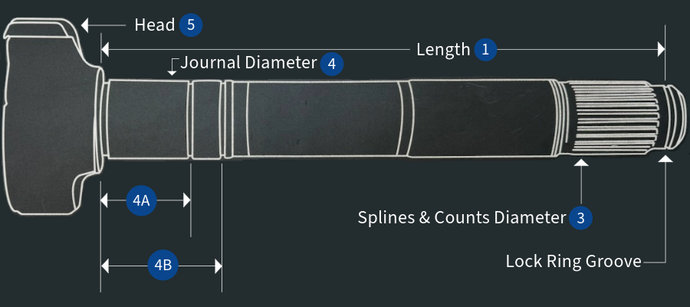
Step 1: Measure the Shaft Length
Using a tape measure, measure the total length of the S-camshaft from end to end. Measure from under the camshaft head to the beginning of the lock ring groove at the splines. Measuring the overall length accurately is important to ensure you’re getting the right replacement part.
Step 2: Identify the Camshaft Type
Before measuring, you’ll need to know which type of S-camshaft you have. S-camshafts vary depending on the vehicle’s make, model, and axle type. There are two main types: - Left-hand (LH): Designed for use on the left side of the vehicle. - Right-hand (RH): Designed for use on the right side.
The difference lies in the direction in which the “S” curve of the camshaft faces, which is crucial for proper brake operation. Make sure you’re measuring the correct one for your application.
2A: Head Type
Determine the camshaft head type by reviewing the drawing and select the type number. Measure the head diameter and select the type number that is best represented.

Step 3: Splines and Counts
Next, you’ll need to measure the spline diameter with the caliper and count the number of splines.
Tech Tip: Most camshafts are 1.50” spline diameter, with a few exceptions at 1.25” and 1.625”. Most spline counts are a 10 or 28 spline.
Step 4: Journal Diameter
Measure the camshaft journal diameter with the caliper.
4A (refer to chart)
Measure the length of the spider bushing journal from under the camshaft head to the beginning of the first lock ring groove.
4B (refer to chart)
Not all camshafts have double grooves. Measure the length of the spider bushing journal from under the camshaft head to the beginning of the second lock ring groove if applicable.
Step 5: Head End
Confirm axle location (steer, drive, trailer), brake manufacturer, and size.
Step 6: Check for Wear and Tear
While measuring the dimensions of the S-camshaft, inspect it for signs of wear. Look for: - Flat spots on the cam head. - Worn or chipped splines at the end of the shaft. - Grooves or scoring along the shaft. - Rust or corrosion, which can weaken the shaft.
If any of these are present, it’s time to replace the S-camshaft, even if the measurements are still within acceptable ranges.
Step 7: Compare with Specifications
Once you’ve recorded all measurements, compare them to the original specifications provided by the manufacturer or the vehicle’s service manual. If the measurements fall within the acceptable range and no significant wear is observed, your S-camshaft is in good condition. If not, replacing it is crucial to maintain safe braking performance.

Conclusion
Regular inspection and measurement of your S-camshaft are vital for ensuring the safety and efficiency of your vehicle’s braking system. A worn or improperly sized S-camshaft can lead to uneven braking, reduced stopping power, or even brake failure. Always make sure to measure accurately and replace the camshaft if it shows signs of wear. Keeping this component in top condition ensures smoother operation and helps you avoid costly repairs down the line.
By following these steps, you’ll be able to properly measure your S-camshaft and ensure that it meets the required specifications for your vehicle.
Related posts
Are you conducting a complete brake job?
Brake system issues are a leading cause of out-of-service violations. When performing brake maintenance, it is important to inspect and maintain the entire braking system to prevent these violations. The goal is not to have more brake jobs, but rather for brake jobs to be more complete, resulting in more uptime.

Great American Inc. Is Going Pink!
Join us in showing our support for Breast Cancer Awareness. Our 2nd Annual Pink Out Day is Wednesday, October 2, 2024. Wear your favorite pink attire, enjoy some pink treats and win prizes, all in raising awareness and support for Breast Cancer Awareness Month.

Great American Inc. Sponsors ALS Charity Golf Tournament
Great American Inc. proudly sponsors a hole to support Josh Harris in his courageous battle with ALS. This event is more than just a game—it's a chance to raise awareness and provide financial support to Josh and his family as they navigate the challenges of this devastating disease. Together, we can make a difference in the fight against ALS.

Employee Of The Quarter - Dusty Veal
Employee of the Quarter: Dusty Veal! 🎉 Dusty’s leadership, work ethic, and positive attitude have made a huge impact at our East Dublin location and beyond. Learn more about why Dusty is such an important part of our team — read the full story here!